Early this year, First Real Estate Investment Trust (“First REIT”) renegotiated its master lease agreements (“MLAs”) with its lessees – PT Lippo Karawaci Tbk (“LPKR”) and PT Siloam International Hospitals Tbk (“Siloam”). While net income did not improve much from last year, Siloam’s growth may allow First REIT’s income to recover earlier.
1H21 operating results
Due to the lower base rent negotiated in the MLAs, rental and other income only increased by 0.9% YoY to SGD 38.9m and net property and other income increased by 0.2% to SGD 37.6m. However, total return for the period after income tax increased by 53.4% to SGD 19.2m due to much higher net fair value gains of derivatives financial instruments.
On the other hand, Siloam performed very well in 1H21 with revenue and net profit increasing by 51.7% and 333.5% YoY to IDR 3811.50b and IDR 302.10b respectively. Although much of it can be contributed to the low base effect, when compared to 1H19 results, revenue increased by 12.9% and profit before tax increased by 446% to IDR 468.89b.
Furthermore, in 2019, Siloam had 18 loss-making hospitals. In 1H21, 10 of them have turned profitable and the EBITDA of these 18 hospitals are now positive. This is also good news for First REIT as the variable/performance-based rent of the MLAs takes 8% of the preceding financial year hospital’s gross operating revenue on an asset-by-asset basis.
Siloam has started paying its portion for rent directly to First REIT since March 21, and will gradually increase its share of the rental payment. Currently, Siloam pays 6% of each hospital’s revenue as rental but this will increase to 6.5% by October 2026, with LPKR paying for the remaining 1.5% of the preceding year’s gross operating revenue.
For LPKR, gross profit increased by 42.5% YoY in 1H21 to IDR 2.94t and they made a profit before tax of IDR 332.36b. Losses for the period decreased to IDR 19.49b from IDR 1.22t in 1H20. However, IDR 777.64b was recorded as gain from business combination due to the acquisition of Lippo Malls Indonesia Retail Trust (“LMIRT”). Adjusting for this and other fair value gains, adjusted loss came in at ~IDR 969.10b in 1H21, compared to ~IDR 1.70t in 1H20. A big detractor of their profits is higher financial charges with higher lease liabilities and loan payments. Accounting for that, adjusted EBITDA increased significantly to IDR 1.01b in 1H21.
Despite its shaky earnings, LPKR has significant amounts in inventories and investment properties that is sufficient to cover its debt.
Credit discussion
LPKR has a low risk of default with about IDR 2.32t of debt expiring by 2022. Its cash position of IDR 5.62t is more than enough to cover for them although they are loss-making. Its EBITDA/interest stands at 2.4x in 1H21 and adjusted interest coverage ratio is at ~1.24x. Net gearing ratios are decent with net debt/total assets and net debt/total equity at 27% and 77% respectively. Siloam has much healthier credit ratios with total debt/total assets at 7.94%. Its cash balance of IDR 849.84b can easily cover for its total debt and lease liabilities of IDR 693.68b.
For First REIT, it has SGD 98.6m of debt expiring in May 2022 with only SGD 36.6m cash at hand. Its gearing ratio of 34.7% indicates that it can take on more debt with a debt headroom amount of SGD 314.0m. Its effective interest rates for its bank loans range from 1.94% to 4.75% per annum. With an adjusted EBIT/interest expense ratio of 3.77x, we believe that First REIT still has a low refinancing risk. However, if First REIT raises debt through the public markets, it may not be able to raise debt at such low interest rates.
Bonds and perpetual securities
To estimate the rates at which First REIT has to issue bonds at, we can look at bonds issued by LMIRT and LPKR. First REIT has slightly better credit profile than the two of them and should also outperform LMIRT given that the Indonesian healthcare sector is doing better than its retail counterpart.
Figure 1: Relative valuation among LMRTSP and LPKRIJ USD bonds
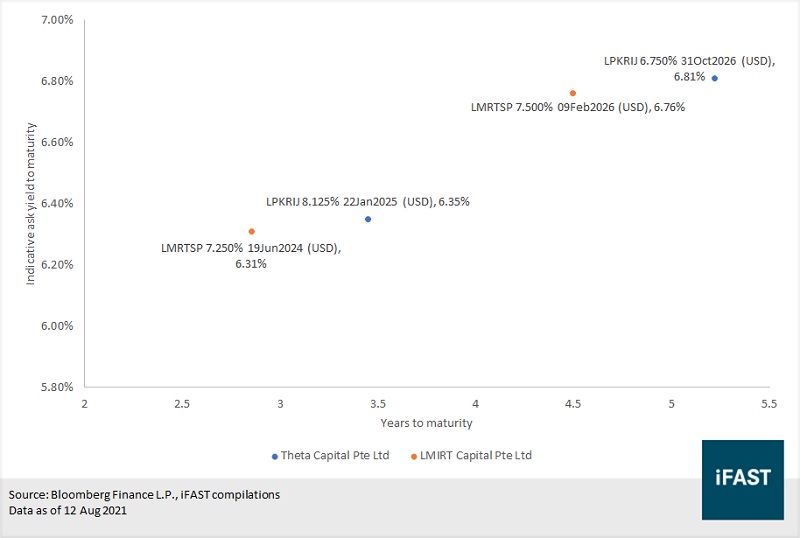
Should First REIT not
refinance its loans with the banks, it can probably turn to the public markets
with a bond offering. Looking at Figure 1, First REIT may have to issue debt in
the 6% region.
Following this argument, if First REIT were to issue perpetual securities to call back the existing FIRTSP 4.9817% Perpetual Corp (SGD), they would need to issue at much higher coupon rates since perps are ranked lower in the capital structure.
Looking at their debt obligations, First REIT may call the perps on any distribution date. Its next reset date is on 8 Jul 2026 and will reset to the sum of the 5-year SGD swap offer rate (“SOR”) and initial spread of 392.5 basis points (“bps”).
On a side note and referring to Figure 1, the LMRTSP 7.250% 19Jun2024 Corp (USD) looks attractive if investors are able to invest at its indicative ask yield-to-maturity of 6.31%.
Rental and growth trajectories
Assuming Siloam manages to grow its revenue 10% annually which fulfils the condition of the variable rent, Siloam’s rent will hit SGD 85m by 2025, which is slightly higher than the base rent in 2019, before the new MLAs were signed. While calculations are simple, this should provide a decent guideline for analysis. If Siloam were to continue its strong performance, there may be a chance for First REIT to call its perps in 2025 as its credit spreads tighten.
Using the base rent escalation of 4.5% annually, the year in question changes from 2025 to 2029. Thus, there may be a high chance that First REIT will call the perps in 2026, depending on the level of the benchmark rates. Using a price of 57.5, the equivalent yield-to-call (“YTC”) for a call date of 8 Jul 2026 is estimated to be at 19.4%. Of course, if First REIT decides to call the perp earlier, the YTC will subsequently be higher.
When compared to its stock and using the more bullish scenario, the stock can possibly grow its dividends by 11% annually. In this scenario, if an investor invests at a unit price of SGD 0.265, a capital appreciation of 26.7% is adequate enough to have total returns equivalent to investing in the perp, assuming it is called in July 2026.
We use the following assumptions:
1. Siloam grows its revenue by 10% annually;
2. This allows First REIT to collect variable rent which is 8% of Siloam’s gross operating revenue;
3. We use an operating margin of 85% and a net income margin of 35%;
4. First REIT pays all remaining net income to unitholders after making distributions to perpholders.
For the stock to appreciate by about 20%, investors may want to see evidence that Siloam’s revenue growth is sustainable. While REITs do not usually appreciate that much, First REIT’s recent rights issue might have helped to bolster its balance sheet. After all the units have risen by about 30% since its rights issue. If Siloam continues on its growth trajectory, its stock price may continue to appreciate. Furthermore, at an NAV/unit of SGD 0.35, its price-book ratio is about 0.76. If the price-book ratio recovers to 1, the stock will appreciate by about 32%. This seems to make the stock a better investment compared to the perp.
Compared to the LMRTSP 6.600% Perpetual Corp (SGD), both FIRTSP 4.9817% Perpetual Corp (SGD) and LMRTSP 6.600% Perpetual Corp (SGD) have similar YTCs with the latter having an estimated YTC of 19.77% at a call date of Jun 26.
However, First REIT seems to be doing better than LMIRT currently. For the LMRTSP 7.000% Perpetual Corp (SGD) to have a similar YTC of 19% in 2026, it needs to be priced at about 61. This valuation is based on an assumed coupon rate of 6.1925% as the LMRTSP 7% perps will likely reset to a new reference rate next month. Given the current economic situation, First REIT should be in a better shape as malls in Indonesia are still operating at restricted capacity. Thus, we have a stronger preference for the FIRTSP 4.9817% Perpetual Corp (SGD) over the LMRTSP notes.
Our podcast series, Yield Hunters, is available on Spotify, iTunes Podcasts and Google Podcasts. We share our thoughts on new bond issues and hold discussions on the fixed income space. Listen to our latest episode below and follow us!